Recently, the potato research team at our institute published a study titled "Genetic architecture and major genes for tuber skin texture in potato" in Horticulture Research (IF=8.5). This study systematically elucidates the relationship between potato tuber skin texture and cellular structural features, as well as the accumulation of suberin and lignin. A major quantitative trait locus (QTL) controlling tuber skin texture was identified on chromosome 4, and the key gene StPXG4, along with its upstream regulatory factors, was characterized. This study provides crucial gene resources for improving the appearance quality of potato tuber.
Potato (Solanum tuberosum L.) is the third most important food crop worldwide and plays a critical role in ensuring world food security. Tuber skin texture not only directly influences the appearance quality of potatoes but is also closely related to traits such as disease resistance, stress tolerance, and resistance to mechanical damage. While smooth-skinned tubers exhibit good appearance, they are generally more susceptible to diseases and physical injury; russet-skinned tubers, on the other hand, possess enhanced resistance to damage and disease but are predominantly utilized for processing purposes. However, the genetic basis and regulatory mechanisms underlying tuber skin texture remain largely unknown.
To address this knowledge gap, this study conducted histological sectioning and scanning electron microscopy observation on tuber skins at various developmental stages of the smooth-skinned variety 'Zhongshu Zao 43' (Z43) and the russet-skinned variety Innovator. The results revealed that during tuber expansion, the tuber skin of Innovator progressively developed cracks. The tissue adjacent to these cracks exhibited upward curling while remaining attached to the underlying newly formed phellem layer. Further analysis of cell wall components confirmed that the accumulation of lignin and suberin is closely associated with skin texture.
Based on these findings, this study utilized an F1 genetic population derived from a cross between Z43 and Innovator, in combination with bulked segregant analysis (BSA) mapping, transcriptome analysis during tuber skin development, and gene expression analysis across varieties with different skin textures. A major QTL controlling skin texture was mapped to chromosome 4, and within this region, the key gene peroxidase StPXG4 was identified. Co-expression analysis further revealed that the MYB transcription factors StMYB103 and StMYB58 were highly correlated with StPXG4, suggesting their potential roles in regulating StPXG4, thereby influencing the deposition of suberin and lignin and ultimately determining skin texture.
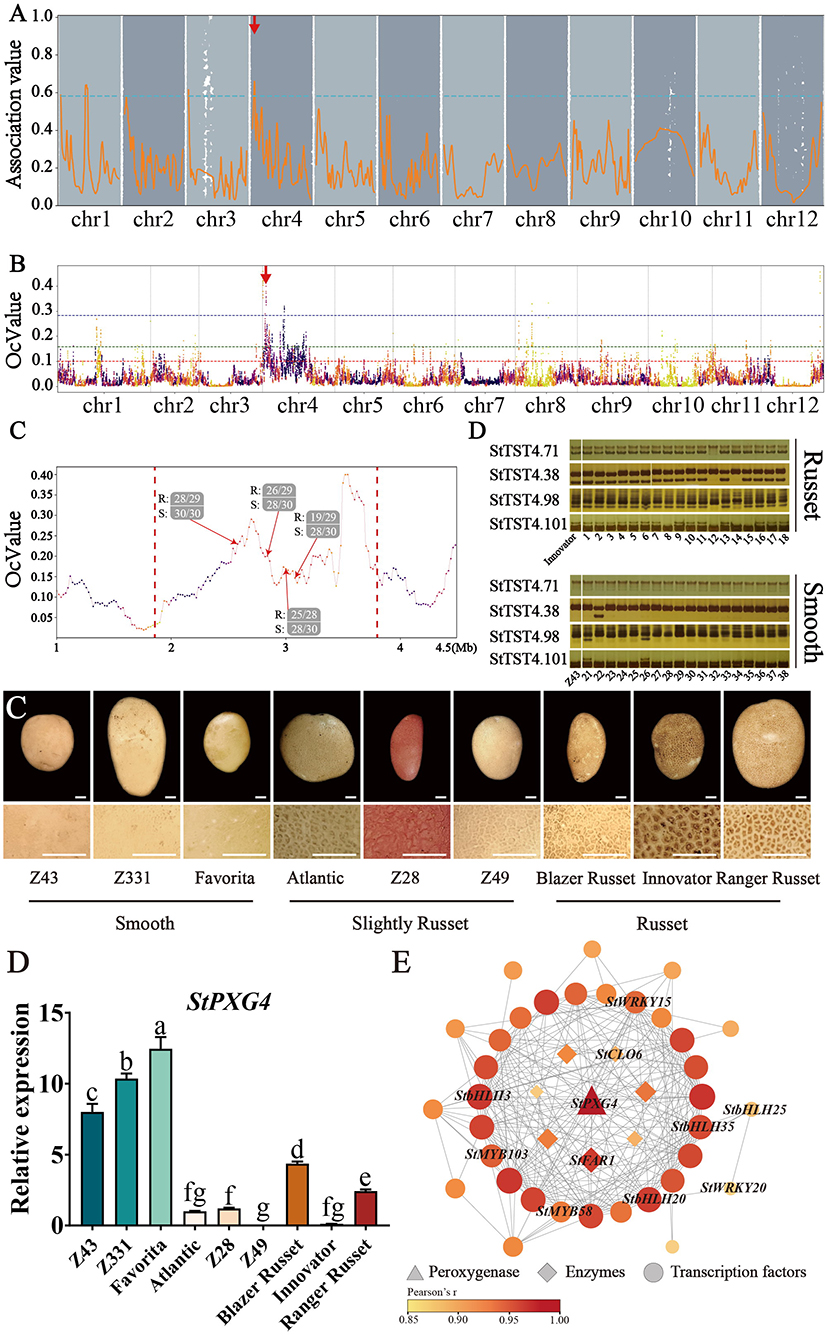
Additionally, four Indel molecular markers were developed within the QTL interval. In the F1 population, the consistency between marker genotype and phenotype exceeded 80% for these markers, with three markers achieving a concordance rate above 90% consistency. This research not only provides important targets for the targeted improvement of potato skin texture and germplasm innovation but also offers valuable tools for molecular marker-assisted breeding.
Zhang Renhong and Wang Shuo, master's graduates from our institute, are the co-first authors of this paper, with Professors Xu Jianfei and He Ming serving as corresponding authors. This work was supported by the National Natural Science Foundation of China (Grant No. 32172090) and the China Agriculture Research System (CARS-09).
Original link: https://academic.oup.com/hr/advance-article/doi/10.1093/hr/uhag102/8519595?login=true

 Chinese